In the realm of modern mining and large - scale construction, autonomous dump trucks have emerged as a game - changer. As a leading supplier of autonomous dump trucks, I've witnessed firsthand how these remarkable machines are revolutionizing the industry. One of the most crucial aspects of their operation is route optimization, which not only enhances efficiency but also significantly reduces operational costs.
The Significance of Route Optimization
Route optimization for autonomous dump trucks is far from a simple task. In mining sites or large construction areas, the terrain can be highly complex, with uneven ground, potential hazards, and constantly changing conditions. By optimizing routes, we can ensure that these trucks can transport materials from the extraction point to the dumping site in the most efficient and safe manner possible.
Efficiency is the primary goal. Every minute saved in transportation means more loads can be carried out within a day, thereby increasing the overall productivity of the site. Moreover, optimized routes can reduce wear and tear on the trucks. By avoiding rough or unnecessary paths, the mechanical components of the trucks, such as the suspension, tires, and engine, are subject to less stress, which extends their lifespan and reduces maintenance costs.
Safety is another critical factor. Autonomous dump trucks are large and heavy vehicles. An optimized route can help them avoid areas with high risks of collisions, such as narrow passages with heavy traffic or areas prone to landslides. This not only protects the trucks themselves but also the workers and other equipment on the site.
Technologies Enabling Route Optimization
GPS and Mapping Systems
Global Positioning System (GPS) technology forms the backbone of route optimization for autonomous dump trucks. High - precision GPS receivers on the trucks can accurately determine their position in real - time. Combined with detailed digital maps of the mining or construction site, the trucks can plan the most direct and efficient routes. These maps are often created through aerial surveys or LiDAR (Light Detection and Ranging) technology, which can capture the three - dimensional topography of the area with high accuracy.
For example, if there is a new excavation area or a change in the dumping location, the digital map can be updated, and the trucks can adjust their routes accordingly. This real - time adaptability is essential in dynamic work environments.
Sensor Technology
Autonomous dump trucks are equipped with a variety of sensors, including cameras, radar, and ultrasonic sensors. These sensors play a vital role in route optimization. Cameras can provide visual information about the surroundings, allowing the trucks to detect obstacles, other vehicles, and workers. Radar sensors can measure the distance to objects in front of, behind, and on the sides of the truck, enabling it to make safe and efficient maneuvers. Ultrasonic sensors are useful for detecting nearby objects at close range, especially when the truck is backing up or operating in confined spaces.
By continuously analyzing the data from these sensors, the trucks can adjust their routes to avoid potential collisions. For instance, if a worker suddenly enters the planned route, the truck's system can quickly detect this through the camera and sensor data and reroute to a safer path.
Machine Learning and Artificial Intelligence
Machine learning and artificial intelligence algorithms are at the heart of the decision - making process for route optimization. These algorithms can analyze historical data on traffic patterns, terrain conditions, and vehicle performance. Based on this analysis, they can predict the best routes for different scenarios.
For example, during peak hours at a mining site, there may be more traffic on certain roads. The machine - learning algorithms can analyze past traffic data and determine alternative routes that are less congested. Additionally, these algorithms can learn from the truck's own driving experience. If a particular route has consistently led to better fuel efficiency or fewer delays, the system can prioritize this route in future operations.
Factors Considered in Route Optimization
Terrain and Gradient
The terrain of the mining or construction site has a significant impact on route optimization. Steep gradients can increase the energy consumption of the trucks, as they require more power to climb uphill and more braking force to descend safely. Therefore, routes with shallower gradients are generally preferred.
Moreover, uneven terrain can cause excessive vibrations and stress on the trucks, leading to faster wear and tear. The route - planning system takes into account the elevation changes and the roughness of the ground to select the smoothest and most energy - efficient paths.
Traffic Conditions
Just like in regular road traffic, traffic conditions in a mining or construction site can affect the efficiency of autonomous dump trucks. The presence of other vehicles, such as loaders, excavators, and smaller transport trucks, needs to be considered. The route - optimization system can analyze real - time traffic data from the sensors on all the vehicles in the area and plan routes to avoid congestion.
For example, if a particular intersection is frequently congested during a certain time of the day, the system can direct the dump trucks to use alternative routes or adjust their schedules to avoid peak traffic times.
Loading and Unloading Points
The location and accessibility of the loading and unloading points are crucial factors in route optimization. The trucks need to be able to reach these points safely and efficiently. The route - planning system takes into account the size and turning radius of the trucks to ensure that they can maneuver easily at the loading and unloading areas.
Additionally, the system may consider the sequence of loading and unloading. For example, if there are multiple loading points and unloading points, the system can optimize the route to minimize the total distance traveled while ensuring that all the necessary loads are transported.
Real - World Examples of Route Optimization
In a large - scale mining operation, our autonomous dump trucks were deployed to transport ore from multiple excavation sites to a central processing plant. The mining site had a complex network of roads, with varying terrain and traffic conditions.
Using GPS and mapping systems, we created detailed digital maps of the site, including the location of all the excavation sites, the processing plant, and the roads. The trucks were equipped with sensors to detect obstacles and other vehicles in real - time. Machine - learning algorithms analyzed historical data on traffic patterns, terrain conditions, and vehicle performance to optimize the routes.
Initially, the trucks were following a fixed set of routes. However, as the operation progressed, the system started to adapt to the changing conditions. For example, during rainy seasons, some of the roads became muddy and difficult to navigate. The system quickly detected this through the sensors on the trucks and rerouted the trucks to drier and more stable roads.
As a result, the overall productivity of the mining operation increased significantly. The trucks were able to transport more ore within a day, and the fuel consumption was reduced due to the optimized routes. The wear and tear on the trucks also decreased, leading to lower maintenance costs.
Our Autonomous Dump Trucks for Sale
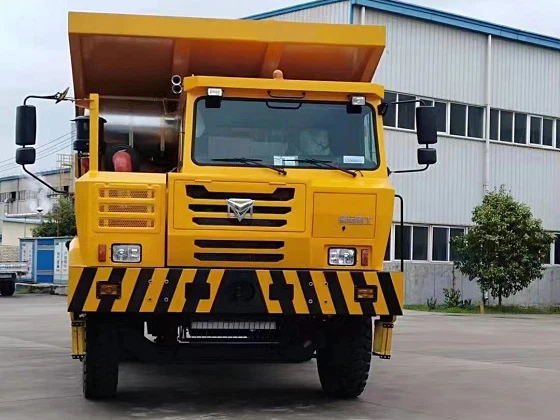
We offer a wide range of autonomous dump trucks to meet the diverse needs of our customers. Our Wide Body Diesel Engine Mine Truck is designed for heavy - duty mining operations. It has a powerful diesel engine and a large payload capacity, making it suitable for transporting large quantities of ore or other materials.
The 12 Tons Mining Truck is a more compact option, ideal for smaller mining sites or construction projects. It offers excellent maneuverability and fuel efficiency, while still being able to carry a substantial load.
For larger - scale operations, our 60 Tons Wide Body Dump Truck is the perfect choice. With its massive payload capacity and advanced autonomous features, it can significantly improve the productivity of your mining or construction project.

Contact Us for Purchase and Consultation
If you are interested in our autonomous dump trucks or want to learn more about how they can optimize their routes to benefit your operation, we encourage you to contact us. Our team of experts is ready to provide you with detailed information, answer your questions, and assist you in making the right choice for your business.
References
- "Autonomous Vehicle Technology: A Guide for Policymakers" by the RAND Corporation
- "Mining Automation: Trends and Challenges" in the International Journal of Mining, Reclamation and Environment
- "Route Optimization Algorithms for Logistics and Transportation" in the Journal of Transportation Research Part E: Logistics and Transportation Review