

In the world of heavy - duty construction and mining operations, the Articulated Dump Truck (ADT) stands as a workhorse, capable of transporting large volumes of materials across challenging terrains. As a leading supplier of Articulated Dump Trucks, we understand the critical role that communication systems play within the cab of these powerful machines. This blog will explore the various communication systems available in the cab of an Articulated Dump Truck, highlighting their functions, benefits, and how they contribute to the overall efficiency and safety of operations.
1. On - Board Diagnostic Communication System
One of the fundamental communication systems in the cab of an Articulated Dump Truck is the on - board diagnostic (OBD) system. This system continuously monitors the performance of various components in the truck, such as the engine, transmission, brakes, and hydraulic systems. Through a network of sensors placed throughout the vehicle, the OBD system collects data on parameters like temperature, pressure, and speed.
The collected data is then transmitted to the cab's display unit, where the operator can view real - time information about the truck's health. For example, if the engine temperature exceeds the normal range, the OBD system will alert the operator, allowing them to take immediate action to prevent potential damage. This proactive approach to maintenance not only reduces downtime but also extends the lifespan of the truck.
Moreover, the OBD system can communicate with external diagnostic tools. When the truck needs servicing, technicians can connect a diagnostic scanner to the truck's OBD port. The scanner can then retrieve detailed diagnostic trouble codes (DTCs) from the system, which helps in quickly identifying and resolving issues. This seamless communication between the truck and external tools streamlines the maintenance process, ensuring that the truck is back on the job as soon as possible.
2. Radio Communication System
Radio communication is a vital part of the communication infrastructure in an Articulated Dump Truck. In construction and mining sites, where multiple vehicles and workers are operating simultaneously, clear and reliable radio communication is essential for coordinating operations.
The cab of an ADT is typically equipped with a two - way radio system. Operators can use this system to communicate with other drivers, supervisors, and ground crew. For instance, if there is a change in the loading or unloading location, the supervisor can quickly inform all the truck operators via the radio. This real - time communication helps in optimizing the workflow, reducing waiting times, and improving overall productivity.
In addition, radio communication can enhance safety on the site. In case of an emergency, such as a breakdown or an accident, the operator can immediately alert others using the radio. This allows for a rapid response, potentially preventing further damage or injury. The radio system is also useful for sharing information about road conditions, traffic, and any potential hazards on the site.
3. GPS and Telematics Communication System
Global Positioning System (GPS) and telematics technology have revolutionized the way Articulated Dump Trucks are managed. The GPS system in the cab provides accurate location information, which can be used for various purposes.
Firstly, it helps in route planning. Operators can use the GPS to find the most efficient routes to the loading and unloading sites, taking into account factors such as distance, traffic, and terrain. This not only saves time but also reduces fuel consumption. Secondly, the GPS system can be integrated with a telematics platform. Telematics allows for the remote monitoring of the truck's performance, including speed, fuel usage, and idle time.
The telematics system communicates with a central server, where fleet managers can access real - time data about all the trucks in the fleet. This data can be used for performance analysis, driver behavior monitoring, and maintenance scheduling. For example, if a particular driver has a habit of excessive idling, the fleet manager can use the telematics data to provide targeted training to improve fuel efficiency.
Furthermore, GPS and telematics can enhance security. In case of theft, the GPS can be used to track the location of the truck, increasing the chances of recovery. The system can also be set up to send alerts if the truck leaves a predefined geographical area, known as a geofence.
4. In - Cab Display and Control Communication System
The in - cab display and control system is the interface through which the operator interacts with the truck's various functions. It consists of a dashboard display, control buttons, and touchscreens.
The dashboard display provides essential information such as speed, fuel level, engine RPM, and warning lights. This information is presented in a clear and easy - to - read format, allowing the operator to quickly assess the truck's status. The control buttons and touchscreens are used to operate different systems in the truck, such as the transmission, hydraulic lift, and lighting.
The in - cab display and control system communicates with the truck's electronic control units (ECUs) to ensure smooth operation. For example, when the operator presses a button to raise the dump body, the control system sends a signal to the hydraulic ECU, which then activates the hydraulic pump to lift the body. This seamless communication between the operator and the truck's systems enhances the operator's control and reduces the risk of errors.
5. Camera and Sensor Communication System
To improve visibility and safety, modern Articulated Dump Trucks are often equipped with a camera and sensor communication system. Rear - view cameras are a common feature, which provide the operator with a clear view of the area behind the truck when reversing. This helps in avoiding collisions with other vehicles, workers, or obstacles.
In addition to rear - view cameras, some trucks are also equipped with side - view cameras and 360 - degree camera systems. These cameras provide a comprehensive view of the truck's surroundings, eliminating blind spots. The camera system communicates with the in - cab display, allowing the operator to switch between different camera views as needed.
Sensors, such as proximity sensors and radar sensors, are also part of this communication system. Proximity sensors can detect objects in close proximity to the truck and send an alert to the operator if there is a risk of collision. Radar sensors can be used for speed detection and collision avoidance, especially in low - visibility conditions.
6. Communication with Other Vehicles and Equipment
Articulated Dump Trucks often need to communicate with other vehicles and equipment on the site. For example, when loading at a quarry or a mine, the truck may need to communicate with the loading equipment, such as an excavator or a wheel loader.
Some advanced ADTs are equipped with vehicle - to - vehicle (V2V) and vehicle - to - infrastructure (V2I) communication systems. V2V communication allows trucks to exchange information with each other, such as speed, direction, and braking status. This can help in preventing collisions and coordinating traffic flow on the site.

V2I communication enables the truck to interact with the infrastructure on the site, such as traffic lights, weigh stations, and loading bays. For example, the truck can communicate with a weigh station to obtain accurate weight measurements, which are essential for compliance with load limits.
Conclusion
In conclusion, the communication systems in the cab of an Articulated Dump Truck are crucial for ensuring efficient, safe, and productive operations. From on - board diagnostics to radio communication, GPS and telematics, in - cab displays, cameras, and communication with other vehicles and equipment, each system plays a unique role in enhancing the overall performance of the truck.
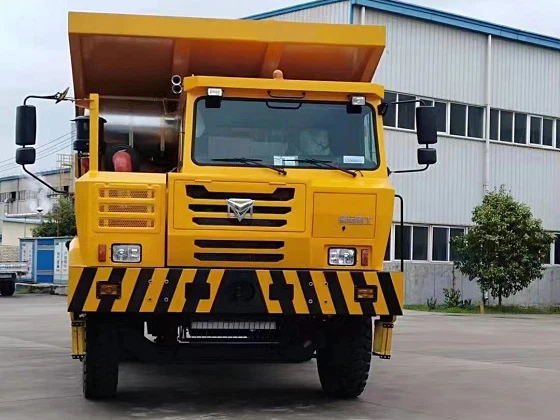
As a [your position] at [your company], we are committed to providing Articulated Dump Trucks equipped with the latest and most advanced communication systems. Our trucks, such as the Articulated Dump Truck, 60 Tons Wide Body Dump Truck, and Mining Drive Vehicle, are designed to meet the diverse needs of our customers in the construction and mining industries.
If you are interested in learning more about our Articulated Dump Trucks and their communication systems, or if you have any specific requirements for your operations, we encourage you to contact us for a detailed discussion. Our team of experts is ready to assist you in finding the best solutions for your business.
References
- SAE International. "On - Board Diagnostic Systems for Heavy - Duty Vehicles." SAE Technical Paper Series.
- Federal Highway Administration. "GPS and Telematics in Fleet Management." FHWA Research Report.
- Construction Equipment Manufacturers Association. "Safety and Communication Systems in Construction Vehicles." CEMA White Paper.


